

This October, as I contemplate my Halloween outfit whilst carving the annual pumpkin and decorating the house with bats and cobwebs, my mind wanders to a different kind of Halloween party. What if this year the guest list looks a little different? Forget witches, vampires and skeletons. Imagine a room packed with a coral reef’s greatest masters of disguise, with outfits so cunning you might just mistake them as part of the decor. This Halloween, I’m inviting the most extravagant critters of the reef to my party, but who deserves the crown for best dressed?

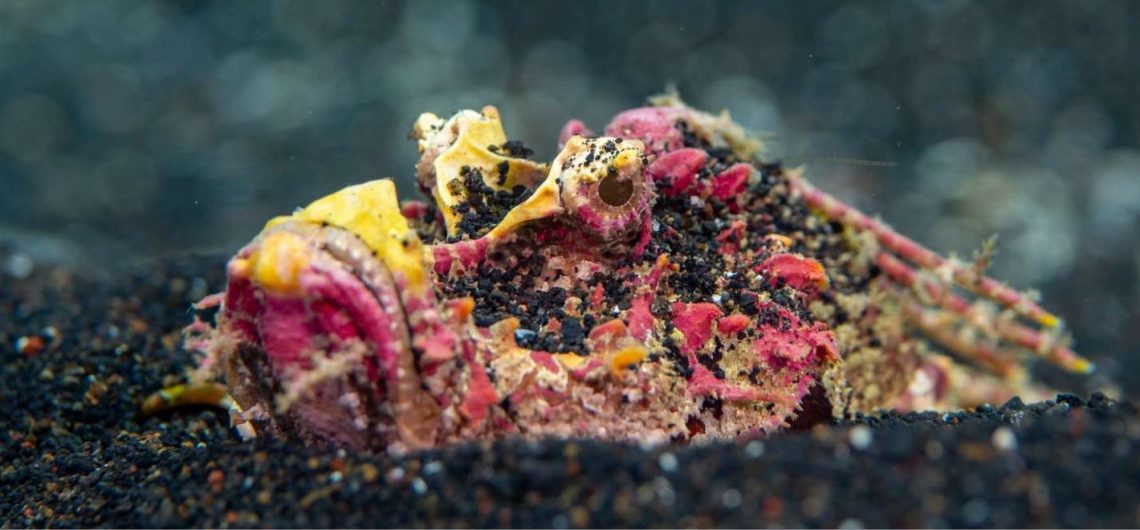
Weedy scorpionfish (Rhinopias frondosa).

Warty frogfish (Antennarius maculatus). Photo by Amy Vankanan.
Decorator Crabs
Chances are, if you’ve ever snorkeled alongside a decorator crab, you had no idea. The one time I recall seeing one was on a night snorkel around Kusu Island. We were shining our torches beneath corals, hoping to spot nocturnal walking sharks, when, to my surprise and delight, I spotted a large spider crab scuttling along, startled by my light. He was wearing what can only be described as a sponge hat. I couldn’t help but laugh out loud, choking a little on the water in my snorkel (karma for scaring him, I guess).
There are around 700 species of decorator crab found in seas and oceans around the world, across a range of climates, all using the same ingenious trick to go unnoticed. These crabs choose organisms such as sponges, soft corals, sea squirts, brittle stars, snails and seaweed, pretty much anything that moves very little. They then attach these organisms to their shells that are sticky like velcro thanks to being covered in tiny hooks. The end result is a very silly looking crab with immense camouflage capabilities.

Spider decorator crab (Camposcia retusa) Camouflaged in sand and sponges.
The primary purpose of this camouflage is, of course, to hide from predators. But there are other benefits, too, including hiding from prey. A little fish going about its day might not recognize what looks like a harmless sponge as a threat, and then BAM! Suddenly, it’s been snapped up by a crab in disguise. Some clever crabs even use organisms containing toxins to decorate themselves, effectively borrowing their chemical defenses for their own protection.
Decorator crabs definitely make the cut for my Halloween party guest list and win the prize for most resourceful!
Now, frogfish might not be the most fun at a party, as they prefer their own company and aren’t fans of direct eye contact, but you have to give them credit for their commitment to never breaking character.
These fish are my absolute favorite. Being extremely camouflaged, the sense of satisfaction you get when you spot one on a snorkel is unmatched. Characterized by never wanting to turn their frown upside down, their funny little feet-like fins, and their wonderful color combinations, you can’t help but love them. Some names of species include: hairy frogfish, psychedelic frogfish, warty frogfish, shaggy frogfish, and giant frogfish!

Two Hairy Frogfish (Antennarius striatus). Small male, large female. Photo by Amy Vankanan.

Giant Frogfish (Antennarius commerson) camouflaged as a sponge!
Frogfish hide in plain sight by blending in to their surroundings. They do this by changing their skin and leafy-like appendages to mimic the texture and color of the coral, sponge, or algae they are impersonating. These guys are incredibly patient, using the slow and steady approach to hunting. Staying perfectly still and blending in, they wait for prey to swim past their large mouth and pounce when the time is right.
Another very inventive costume accessory is the frogfish’s lure. They literally fish for their prey by dangling a part of themselves that looks like either a little fish, shrimp, or worm as bait off their faces. Fish are attracted to this, and when close enough, BAM! The frogfish strikes.

Giant Frogfish fishing using its lure.
Leaf-like Fish
This is a broad costume category, as there are far too many contestants to mention just one. Unlike the fish mentioned above, these leaf-imitating fish don’t stay in one spot. Instead, like leaves swaying with the motion of the ocean, they allow themselves to be swept along by currents, waves and surge. This, paired with their leaf-like shapes and colors, could fool anyone into thinking they’re simply leaf litter tumbling over the sand, wedged among coral branches or floating along the sea surface!
My top three leaf-like fish:
- Juvenile orbicular batfish (Platax orbicularis):
Juvenile orbicular batfish hide among dead leaves floating on the water’s surface, carried far and wide by the wind. They can end up being carried by currents into the shallows of a beach, around jetty pilings, among patches of rubbish out at sea and beneath mangrove canopies. Wherever they end up, they are extremely hard to spot. They swim horizontally on their sides and are tiny and orange-brown, just like old leaves. As they reach adolescence, they begin to swim vertically like ‘normal fish’. Next time you see some seemingly uninteresting leaf matter, take a closer look you might just find a baby batfish!

Juvenile orbicular batfish.
- Leafy scorpionfish (Taenianotus triacanthus):
All scorpionfish species are, of course, absolute masters of disguise. One of my favorites, however, is the leafy scorpionfish. Often hiding in plain sight, it mimics a dead leaf caught among coral or algae, swaying back and forth with the movement of the water. Leafy scorpionfish can be white, yellow, pink, red, green or brown, depending on their environment. Approximately every couple of weeks, they shed their skin to remove algae build-up and start again with a new color!

Leafy scorpionfish.
- Halimeda Ghost pipefish (Solenostomus halimeda):
These fish are among the hardest species to spot while snorkeling. Seemingly relinquishing all control to the movement of the water, they tumble and sway alongside whichever algae they are impersonating. One of the most camouflaged is the Halimeda ghost pipefish which is almost indistinguishable from its habitat: Halimeda algae.

Halimeda Ghost pipefish (Solenostomus halimeda). **
Leaf impersonating fish are all invited to the party! Their slinky, seaweed-like moves would fire up any dance floor!
**Halimeda Ghost pipefish photograph source: originally posted to Flickr on wikimedia common and shared under the Creative CommonsAttribution 2.0 Generic license.
