


Up until a couple of years ago, I was under the impression that the only behavior that sea stars visibly exhibited was the one where they just stick themselves to the reef, like a gecko on glass. In all my time spent snorkeling and diving all over the world, this is all I’d ever seen them do. Then, I saw this amazing photo of a sea star arched up on all five of its legs, with what looked like white smoke being released from its body. It was a completely new way to see a sea star, extremely photogenic, and interesting; I hoped I’d be able to observe this behavior at some point.
 This is a male Leiaster leachi sea star broadcasting sperm into murky water in a shallow bay Other nearby sea stars were broadcasting sperm and eggs into the water in synchrony though the they were not within visual distance of one another Over the course of an hour or more the sea star swayed and twirled as it released streams of sperma five limbed dancer gyrating to a silent timeless rhythm of life This individual was between 40cm and 45cm in diameter Photographed in Kagoshima Prefecture Japan Photo and description by Tony Wu for the Wildlife Photographer of the Year Awards
I didn’t have to wait long; I think it was on my very next trip in Indonesia where the group and I saw not only one, but at least a dozen sea stars in a small area, all exhibiting this unique behavior! And then a few trips later, we experienced the exact same thing, dozens of sea stars all arched up like this, releasing this ‘smoke’! Now, we’re seeing this behavior more and more, every third trip or so, because we now know what to look for and when to look for it. Here’s how you can start to spot this, also!

Like a lot of marine life species, sea stars tend to time all their reproductive business when the tides are at their strongest, which is generally full or new moon. This was exactly when I would encounter all these sea stars standing up, allowing the stronger water movement to carry their gametes further abroad. I’ve since learned that the male and female stars often synchronize their spawning events, and quite often cluster together during this time.
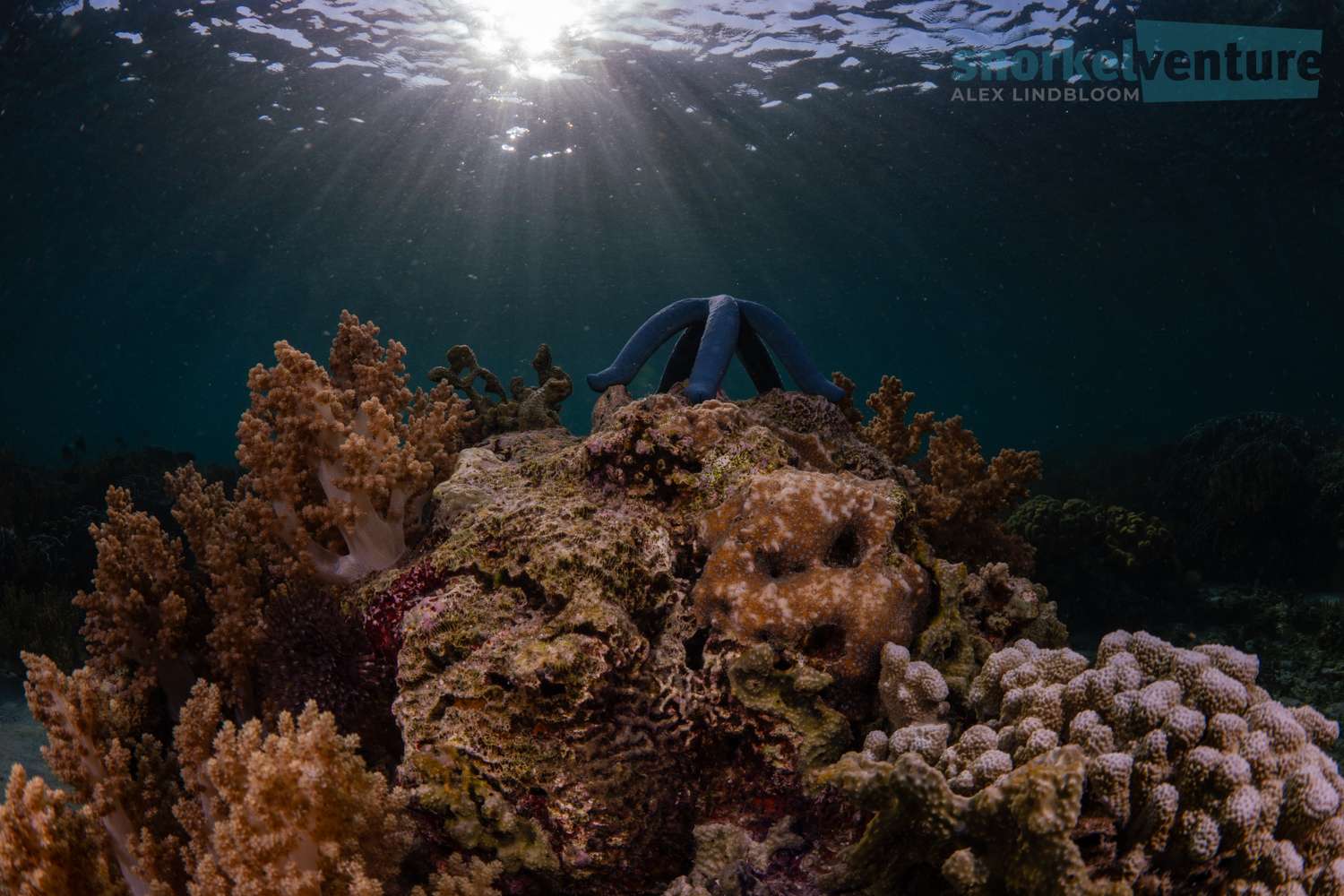
As the female blue sea stars release their eggs, which are usually a bright yellow or orange color, males will simultaneously release a cloud of white sperm into the water. This phenomenon often occurs in shallow waters, which is ideal for us snorkelers. The spawning event may last for a short period, in my experience, about five to ten minutes, and once the gametes are released, the fertilized eggs will drift away, and the sea stars will go back to their regular sea star positions on the reef.
